Travel question
Phoenix in Summer: How Hot It Gets and What Still Works
Researched from traveler reports
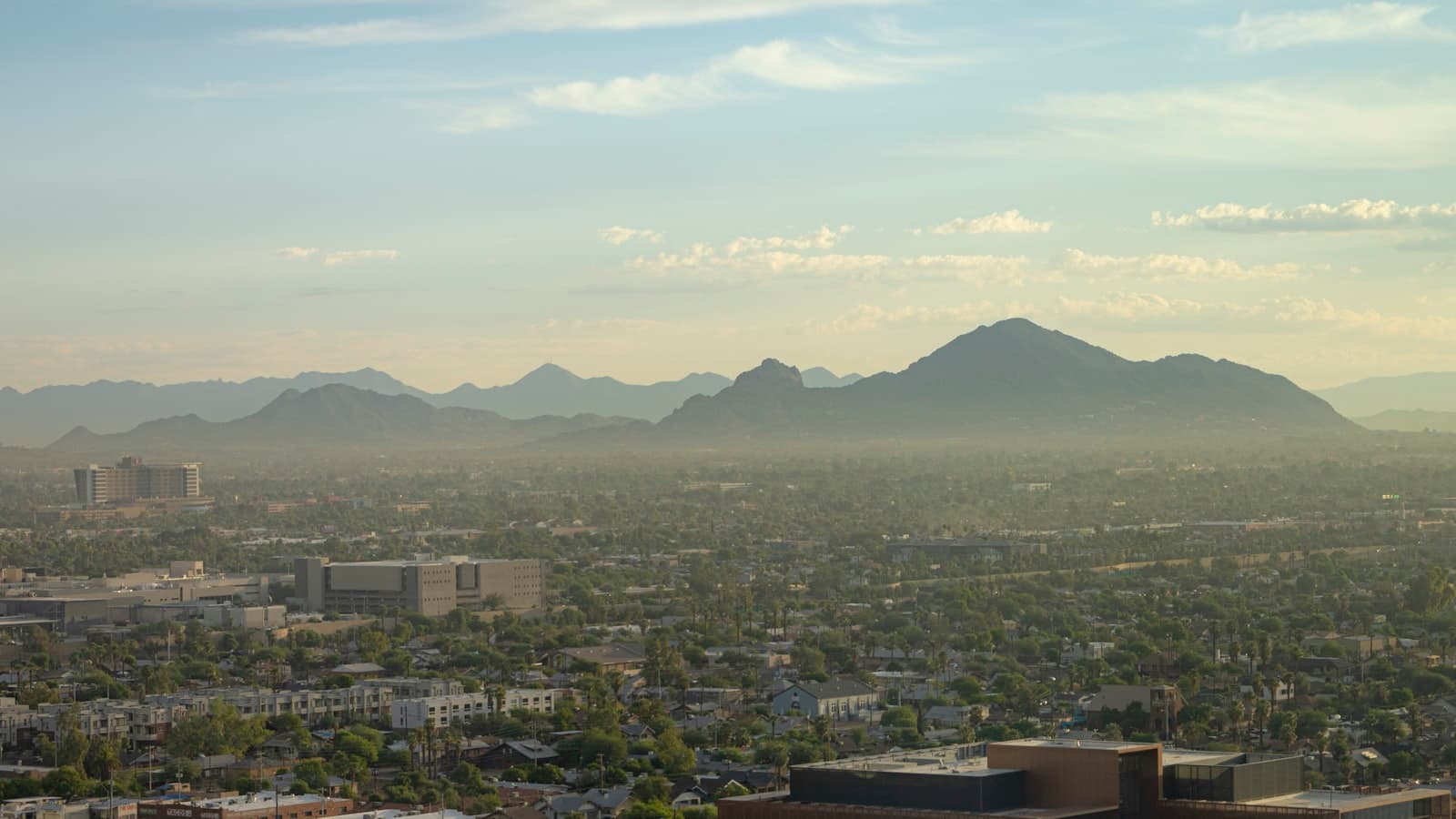
Very hot, and not only at midday: from June through August, Phoenix's normal high runs 104–107°F, many afternoons pass 110°F, and some nights never drop below 90°F. A summer trip still works if you flip the day: be outside from first light until 8 or 9 a.m., spend the afternoon in a museum, a pool or the Salt River, and save the evening for places that stay open late.
How hot Phoenix gets, month by month
June, July and August all average highs above 104°F, and recent summers have run hotter than that. The National Weather Service's 1991–2020 normals for Sky Harbor airport put the average high at 104°F in June, 107°F in July, 105°F in August and 100°F in September. A normal year brings about 111 days at 100°F or more and 21 days at 110°F or more, and the all-time record is 122°F, set on 26 June 1990.
Recent summers. 2024 set the records: 70 days at 110°F or more, and 113 days in a row at 100°F or more. Summer 2026 averaged 97°F from June to August, tying 2023 as the second-hottest on record. June, July and August all ran above normal, and the heat topped out at 117°F in both July and August.
The nights. This is the part that's easy to underestimate. The normal July low is about 85°F, and it only arrives around dawn. Hourly airport readings from July 2026 show how little the evening gives back: just before 9 p.m. the temperature averaged 100°F, and it was 100°F or more on 18 of 31 evenings. Even just before 6 a.m., the coolest point of the day, it averaged 88°F. On 24 July 2026 the low was 97°F, a record, and while an average year has about seven nights that stay at 90°F or warmer, 2024 had 39.
The hours you can actually use
Outdoor time belongs to first light: the sun rises around 5:20 a.m. in June, and on the hottest days the busiest summit trails close at 8 a.m. Arizona stays on Mountain Standard Time all year, so summer sunrises come early (the earliest in 2026 was 5:17 a.m. on 11 June) and late-June sunsets come around 7:40 p.m. Replying to a first-time visitor planning a mid-August trip, one r/phoenix commenter summed up the local routine: "Outdoor stuff 4:30am-8am, then indoor stuff."
The trail rule. Whenever the National Weather Service has an Extreme Heat Warning in effect, the City of Phoenix closes Camelback's Echo Canyon and Cholla trails, the Piestewa Peak summit trail and four South Mountain routes (Holbert, Mormon, Hau'pal Loop and the National Trail from the Pima Canyon trailhead) from 8 a.m. to 5 p.m. It applies on any day a warning is in effect, and in 2024 it added up to 45 closure days between May and mid-October.
Water and turnarounds. The city's hiking advice is to carry more water than you think you need and to head back before you've drunk it all. Its safety page acknowledges that, yes, "it's a dry heat," but warns that "Arizona's temperature can be deceiving and deadly," and more than 200 hikers a year are rescued from Phoenix's desert parks and preserves.
Surfaces burn. Pavement in full sun can reach 140–170°F, hot enough to burn skin within 30 seconds, and the Arizona Burn Center treated a record 157 people for severe contact burns in summer 2024. Wear sturdy shoes, and be careful with seat belts and playground equipment that have been sitting in the sun.
Know the warning signs. Per the National Weather Service, heavy sweating, cool and clammy skin, nausea or dizziness point to heat exhaustion: get into air conditioning, loosen clothing and sip water. Confusion, slurred speech, hot red skin or a body temperature above 103°F point to heat stroke, which is a 911 emergency. This isn't theoretical: by early September 2026, Maricopa County had confirmed 136 heat-related deaths for the year, about double the count a year earlier.
What's still worth doing
The best summer days pair one early outdoor stop with an air-conditioned or wet afternoon, and lean on the places that change their hours for the heat. Most of these are covered in our Phoenix travel guide; this is how they work in summer.
Desert Botanical Garden, early or after dark. The garden stays open until 10 p.m., and in summer 2026 its Desert Oasis season (sunset to 10 p.m. through 30 September, included with admission) lit the trails with twelve light installations, with a different music theme each night. "They are open late for the summer" was one local's tip in that r/phoenix thread.
Japanese Friendship Garden, in two shifts. Its summer schedule splits the day: Tuesday to Sunday from 8 a.m. to 12:30 p.m., then again from 4 to 7:30 p.m., closed through the midday heat.
Museums for the hot hours. The Musical Instrument Museum is open daily from 9 a.m. to 5 p.m. ($24 for adults); most visits last about three hours, and the galleries are busiest from 11 a.m. to 2 p.m., so go at opening. The Heard Museum keeps its 10 a.m. to 4 p.m. hours in summer but closes on Mondays from June through August.
Taliesin West, on the first tour. Frank Lloyd Wright's winter home runs a summer-season audio tour (June to September, $39 for adults) that is a 60- to 75-minute walk, indoors and out. The foundation tells visitors to bring water, sunscreen and a hat, so take the earliest slot you can.
The Salt River. Salt River Tubing runs from late April to the end of September (Fridays to Sundays only for most of September), opening at 9 a.m. on weekdays and 8 a.m. at weekends. A tube and shuttle cost $28, plus a $30 cash deposit per tube; the operator puts floats at two to four hours depending on where you start and how the river is running; riders must be at least 4 feet tall, and glass is banned. Tubers often see the river's wild horses grazing or drinking along the shore, so it pairs well with the guide's sunrise stop at Coon Bluff.
A shaded pool. Pick a hotel with real shade around the pool: "Stay at a decent hotel with a cool pool!" was another tip in that thread. Summer is resort low season, so this costs less than it sounds (prices are in the FAQ below).
Baseball under a closed roof. At Chase Field downtown, the Diamondbacks' retractable roof usually stays shut during the hot months to keep the heat out.
Or head uphill. Flagstaff averages 81°F in July, with lows near 51°F, according to the National Weather Service, and one local in that thread called August the best time of year to skip Phoenix for it. Sedona, lower down, stays much warmer at night. The guide's day trips section covers Sedona and the Grand Canyon.
Monsoon season: storms, dust and flash floods
From 15 June to 30 September, the monsoon can turn a clear afternoon into a dust storm or a flash flood fast, and its rain is hit-and-miss. Sky Harbor got 0.46 inches in July 2026, about half of normal, then a normal August, then 1.05 inches in September, nearly double normal. On 16 September 2026, storms dropped 2 to 4 inches in two to three hours on parts of northern Maricopa and Pinal counties, flooding streets, washes and low-water crossings, and multiple stranded drivers needed swift-water rescues.
If a dust storm hits while you're driving, the Arizona Department of Transportation's advice is to get completely off the road if you can (never stop in a travel lane or the emergency lane), turn off all your lights, set the parking brake, take your foot off the brake pedal and wait it out with your seat belt on. And never drive into a flooded wash; the guide's common mistakes section explains what that can cost you.
Get new guides and seasonal travel tips like this Phoenix heat plan by email, about once a month.
New destination guides and videos, roughly monthly. No spam, unsubscribe anytime.
Quick answers
Is September still too hot in Phoenix?
Mostly, yes. September's normal high is 100°F, and in 2026 it averaged 100.1°F with lows around 81°F; the year's last 100°F day typically comes around 5 October. In 2024 Phoenix hit 110°F as late as 7 October, so don't bank on relief before mid-October.
What is an Extreme Heat Warning?
It's the alert the National Weather Service issues when heat is intense enough to pose major health risks to most people, and there's no single temperature that triggers it. In Phoenix it also triggers the city's daytime trail closures. In summer 2026 one warning lasted 18 days straight, the second-longest on record after 29 days in July 2023.
Is Phoenix cheaper in summer?
For hotels, usually. Summer is resort low season: in 2026 the Boulders advertised summer rates more than 60% below its winter prices, the Westin Kierland added a $100 nightly resort credit from late May through September, and the Wigwam offered discounts to locals and visitors alike. Some of the best deals, such as the Phoenician's local rate, need an Arizona ID, so read the terms.
Can you take a dog on Phoenix trails in summer?
Not on hot days: City of Phoenix rules bar dogs from city trails when it's over 100°F, and a normal year has about 111 days that reach 100°F. The city also suggests checking whether the ground is too hot to touch, carrying water for your dog and watching for heavy panting or vomiting.
When to go, where to stay, what to skip: the rest is in the Phoenix, Arizona travel guide.
Sources and how this article was made
This article isn't based on a summer visit. It's built from National Weather Service records and hourly Sky Harbor observations, City of Phoenix and venue websites, Arizona news reports and resident advice on Reddit, checked on 24 October 2026.
NWS Phoenix: June 2026 climate summary
NWS Phoenix: July 2026 climate summary
NWS Phoenix: August 2026 climate summary
NWS Phoenix: September 2026 climate summary
NWS Phoenix: extreme temperature records and averages
KJZZ: Summer 2026 was the second-hottest on record in Phoenix
KJZZ: The 18-day extreme heat warning, one of the longest ever (August 2026)
KJZZ: 2024, Phoenix's hottest year, by the numbers (January 2025)
Iowa Environmental Mesonet: hourly airport observations archive (Phoenix Sky Harbor, July 2026)
Sunrise and sunset times for Phoenix, 2026
City of Phoenix: Trail Heat Safety Program
City of Phoenix: Take a Hike. Do it Right.
City of Phoenix: trails and dog rules
AZFamily: Phoenix hiking trails close during extreme heat warning (August 2026)
KJZZ: Hot pavement can cause life-threatening burns, Arizona Burn Center warns (June 2025)
National Weather Service: heat illness signs and first aid
Desert Botanical Garden: Desert Oasis Garden After Dark
Japanese Friendship Garden of Phoenix: summer hours
Musical Instrument Museum: plan your visit
Heard Museum: hours and visiting
Frank Lloyd Wright Foundation: Taliesin West tours
Frank Lloyd Wright Foundation: tour FAQ
Salt River Tubing: season, hours, prices and rules
AZFamily: Salt River Tubing returns for another summer (April 2026)
ABC15: Float past wild horses on Arizona's Salt River
AZFamily: Phoenix-area staycation deals for summer 2026
KJZZ: Chase Field's retractable roof (2015)
NWS Flagstaff: summer heat in northern Arizona
NWS Phoenix: 16 September 2026 heavy rainfall and flash flooding
KOLD: ADOT's "Pull Aside, Stay Alive" dust storm driving tips
r/phoenix: "Visiting Phoenix for the first time in mid-August" (thread snapshot, June 2026)