Travel guide
Aruba Travel Guide
Researched guide
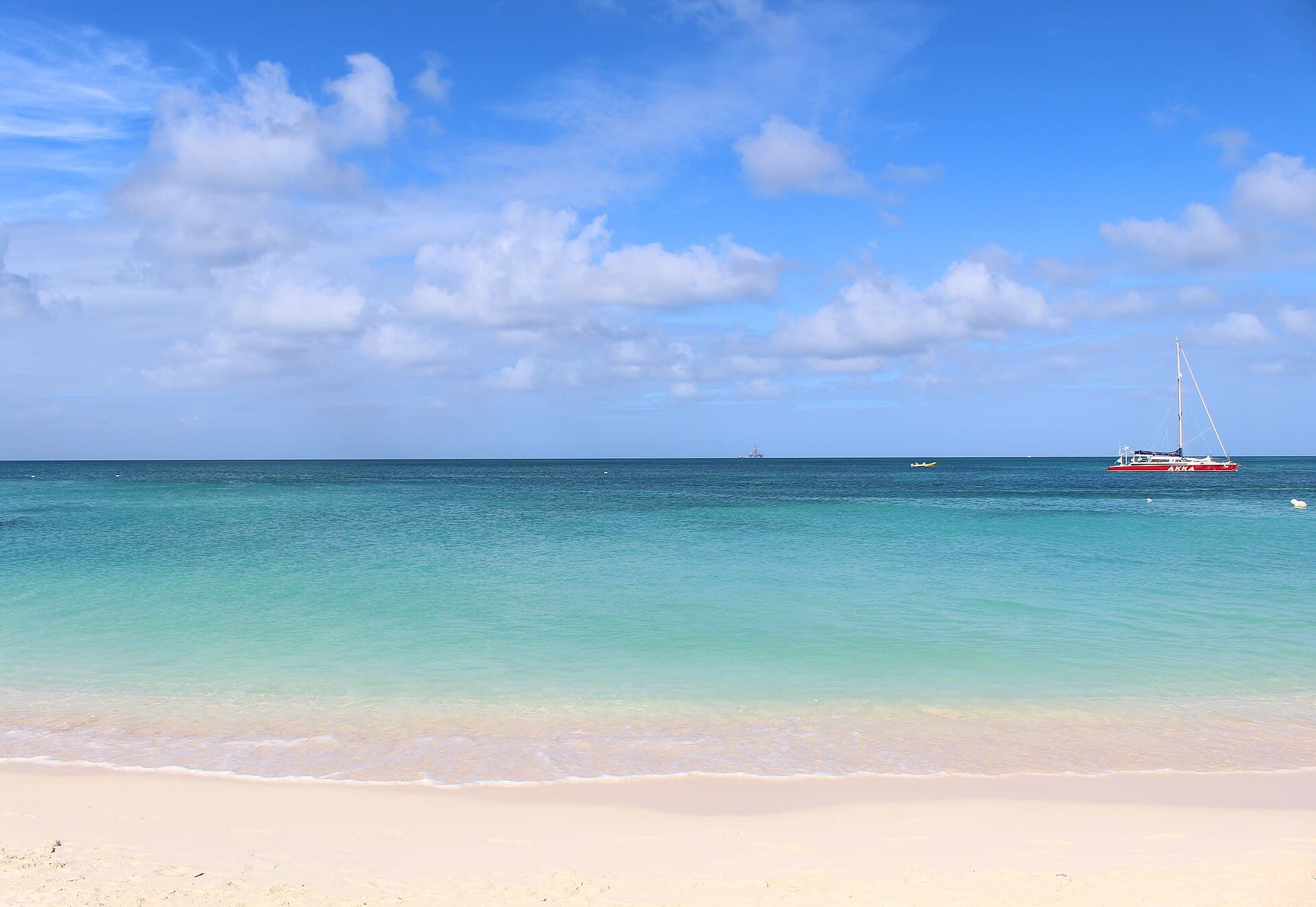
Photo: Coolcaesar, CC BY 4.0
At a glance
- Best time
- April is the driest month; mid-April to mid-December brings lower hotel rates
- Days needed
- 4 to 5, including one or two days with a rental car for the south coast and Arikok
- Getting around
- Arubus buses ($2.60 a ride, $15 day pass) and fixed-fare taxis on the hotel strip; a car for the rest
- Good for
- Calm-water beach days, shore snorkeling, kitesurfing, families
- Skip if
- You want rainforest or bargain prices; restaurant prices run close to US levels
- Entry
- Online ED card plus a $20 sustainability fee, paid before airline check-in
- Money
- US dollars are widely accepted, but ATMs generally dispense Aruban florins
In this guide
Overview
Aruba is a small, dry and windy island in the southern Caribbean, about 20 miles long and part of the Kingdom of the Netherlands. Its resorts are concentrated on the west-coast hotel strip north of , where 's high-rises and 's low-rise hotels line the sand, and steady trade winds take the edge off temperatures of 80 to 90°F all year.
The complaints travelers repeat are about cost and crowds: Palm Beach's sand is packed with chairs, palapas are fought over, and restaurant prices run close to US levels. The fix is to leave the strip for a day or two. The south coast, from 's fishing pier to ' murals and the calm bays beside , is where many locals eat and swim, and it's where most of this guide's hidden gems are.
Aruba suits families, snorkelers, kitesurfers and anyone who wants reliable sun with little planning. It's a poor fit if you want lush rainforest: even October, the wettest month, averages only about 1.3 inches of rain. If you're weighing the neighboring islands, see our Curaçao guide.
Skip or swap
Most regrets in Aruba come from paying resort prices for things that are cheaper nearby, and from following lists that are years out of date.
Skip: a Renaissance Island day pass just for the flamingo photo. Instead: a morning snorkel at . Renaissance Island is one of only two privately owned beaches on Aruba. Hotel guests get in free, but passes for everyone else are limited, don't guarantee access and have changed in price and booking rules over the years, so check with the resort before you plan around it. Tres Trapi costs nothing and is where travelers report sea turtles.
Skip: driving out to see the Natural Bridge. Instead: the Baby Bridge right beside it. Aruba's famous Natural Bridge collapsed on 2 September 2005, and only its remains are left to see. The smaller Baby Bridge next to it still stands, can be reached in a regular rental car and has a shop with food, drinks and restrooms.
Skip: taxis for short hops along the strip. Instead: the bus. Since 20 May 2026, a taxi between and costs a fixed $16, plus $5 on Sundays, holidays and between 11pm and 7am. An Arubus ride costs $2.60, and a day pass is $15.
Skip: on cruise-ship days. Instead: next door, ideally on a weekday. Forum regulars describe Baby Beach as very crowded when ships are in port and with locals at weekends. Rodger's is a short walk west, has the same calm water and is rarely crowded on weekdays.
Skip: hunting for a free palapa on Palm Beach. Instead: Eagle Beach, with your own beach chair. Palm Beach is the most crowded stretch, with chairs packed close together, and Aruba's 2026 beach guidelines treat a hotel-assigned palapa as in use even while its guest is swimming. Eagle Beach is wider and quieter, and any unoccupied public palapa on a public beach is yours to use if you bring a chair.
Best time to visit Aruba
Go in April for the driest weather, or any time from mid-April to mid-December for lower hotel rates. Aruba lies well south of the main Atlantic hurricane belt, so hurricanes are extremely rare.
Seasons. The tourism board splits the year into a dry season (January to April), a windy season (May to October) and a rainy season (October to December). "Rainy" is relative: October, the wettest month, averages about 1.3 inches of rain and April about 0.4 inches, and temperatures sit between 80 and 90°F all year.
Prices. High season runs from mid-December to mid-April. One UK tour operator says room rates drop 20 to 50 percent the rest of the year, and The Points Guy advises booking December-to-April stays six to 12 months ahead.
Wind. The trade winds almost never stop. They keep the heat bearable and make the windy season prime time for kitesurfing at , where summer winds build to 15 to 25 knots, but they also keep the windward north and east coasts rough, so swim on the west and south coasts.
Carnival. The season starts after New Year and ends at midnight on the eve of Ash Wednesday (10 February in 2027), with parades, street parties called jump-ups and steel-pan performances. is considered its birthplace.
Getting around Aruba
Use buses and taxis if you're staying on the and strip, and rent a car for one or two days to reach the south coast, and Arikok National Park.
Bus. Arubus routes L10A, L10B and L10C link the main bus station, across from the cruise port, with the hotel areas as far as the Marriott and Arashi. L1, L2 and L3A run to San Nicolas, L900 continues from San Nicolas to , and only L2 stops at the airport. A ride costs $2.60, a two-ride retour card $5 and a day pass $15 (fares checked in October 2026); passes are sold at resort gift shops and the Oranjestad station booth.
Taxi. Taxis have no meters. The government sets fixed fares by zone, and the current table has applied since 20 May 2026: from the airport it's $26 to Oranjestad, $37 to the Eagle Beach low-rises and $40 to $41 to the Palm Beach high-rises, plus a flat $5 on Sundays, holidays and from 11pm to 7am. Only cars with TX plates are licensed taxis, and the official fares are listed at taxi.aw.
Rental car. Major firms such as National and Sixt rent only to drivers aged 23 and over. Driving is on the right, limits are 30 km/h in town, 60 km/h outside and 80 km/h on faster roads, and cars already on a roundabout have priority. Most gas stations are full-service, with government-set prices. A regular car handles , San Nicolas, Baby Beach, and the Baby Bridge, but the Natural Pool (Conchi) can only be reached by 4x4 or on a tour.
Arikok National Park. Buy the conservation pass at the San Fuego visitor center (daily 8am to 3:30pm) or the Vaderpiet booth (daily 9am to 3pm). Published prices disagree, so check the current fee with the Aruba Conservation Foundation before you go.
On foot. The Linear Park path runs about two miles along the water between the airport and the cruise terminal in Oranjestad, with outdoor workout equipment at Surfside Beach.
Where to stay in Aruba
Base yourself on for space and quiet, on to walk to restaurants and bars, or in if you'll rely on buses. Stay on the south coast only if you'll have a car.
Palm Beach (high-rise hotels). Calm water, watersports and the island's densest strip of restaurants and nightlife, but also the most crowded sand and slightly higher prices. , , and Bugaloe are all close by.
Eagle Beach (low-rise hotels). A wide, quieter beach lined with boutique hotels and condos, at slightly lower prices. The trade-offs: the water can be wavier, and only a few restaurants are within walking distance, though a taxi to Palm Beach is a fixed $16.
Oranjestad. The capital has the main bus station, the marina restaurants, and the Linear Park, and it's $26 by taxi from the airport. Guests of the Renaissance resort get free access to Renaissance Island, the private island that is hard for non-guests to visit.
and . The quiet south puts you near , , and , but only one bus route (L3A, on its return leg) passes through Savaneta, so plan on renting a car.
Where to eat and drink in Aruba
Eat beyond the resort strip at least once. The fish dock in , the Caribbean kitchens around and the spots locals use serve Aruban and Caribbean cooking, often for less than a resort dinner.
(Savaneta). Whole fried snapper, wahoo and head-on shrimp with plantains and pan bati, eaten on the dock. Cash only; the kitchen is closed on Mondays.
(Seroe Colorado, near ). Kamini, who is from Trinidad, serves handmade roti with curry goat, chicken, shrimp or vegetables; roti start at $19 and curry goat is $30 on the October 2026 menu. It's open noon to 7:30pm and closed on Tuesdays.
(Orange Plaza, Oranjestad). A local fisherman opened it in 2013 to sell fried fish and shrimp by the pound, and it now adds Aruban dishes such as keshi yena and okra soup; half a pound of fish is Afl 32 on its menu. Open Tuesday to Sunday, 11am to 10pm.
Coco Plum (Caya G.F. Betico Croes, downtown Oranjestad). An open-air spot just outside the tourist shops for Aruban home cooking, such as stoba, pan bati and whole fish, plus fresh juices; one traveler noted that many of the diners were locals.
(Noord). A roughly 150-year-old country house serving Aruba's national dish, keshi yena (gouda stuffed with spiced chicken), plus goat stew and oxtail soup; ask for the iguana soup, which isn't on the menu. Open daily, 11:30am to 11pm.
(Oranjestad marina). Peruvian cooking on the harbor from chef Teddy Bouroncle: order the ceviche of the day and a pisco sour, and expect a line of walk-ups.
(Savaneta). The splurge: seafood at tables set on the sand, close enough to the water to get your feet wet.
Pastechi. These fried pastries filled with cheese, ham or ground beef are the classic island snack; The Pastechi House in downtown Oranjestad serves them at breakfast and lunch.
Drinks. Start with or (see Hidden gems). on De Palm Pier has live music on Tuesdays (6:30 to 9:30pm) and on Fridays and Saturdays (6:30 to 10pm), with happy hours from 5 to 6pm and 10 to 11pm. on L.G. Smith Boulevard in Oranjestad is an old-school pub popular with locals, open 5pm to 1am (3am at weekends) with live music at weekends; it's closed on Sunday and Monday. , a family rum and vodka distillery in a former ice factory near the cruise terminal, pours tastings and cocktails from noon to 11pm Monday to Thursday and until midnight on Fridays and Saturdays.
Common mistakes
Most first-trip mistakes in Aruba involve paperwork, cash and swimming on the wrong coast, and each has an easy fix.
Leaving the ED card until the airport. Air travelers need an online ED card, and since July 2024 everyone aged 8 and over arriving by air also pays a $20 sustainability fee, which must be paid before airline check-in. Fix: complete both at edcardaruba.aw a few days before you fly; the fee is charged once a year.
Expecting US dollars from ATMs. Travelers have been caught out because ATMs generally dispense florins, even though dollars are accepted almost everywhere. Fix: bring small US bills for cash-only places such as .
Swimming where the current is strong. 's current is strong enough that swimming is strongly discouraged, and even sheltered has strong currents on its reef. Fix: swim on the calm west and south coasts, and stay inside the marked zones at .
Taking a regular rental car to the Natural Pool. Conchi can only be reached by 4x4 or on a tour. Fix: book a jeep, UTV or guided hike, or rent a proper 4x4 and check what the rental contract allows.
Sitting under a hotel's palapa. Under the 2026 beach guidelines, hotel-assigned palapas and loungers count as in use even when their guests step away, and some beach sections are hotel leasehold reserved for guests. Fix: use an unoccupied public palapa with your own chair, or rent a chair and umbrella from a watersports hut.
Packing oxybenzone sunscreen. Aruba banned sunscreens containing oxybenzone in 2020 to protect its reefs. Fix: bring a zinc oxide or titanium dioxide formula, or buy one at a local grocery store or pharmacy.
Turning up on closing day. Zeerovers' kitchen and close on Mondays, closes on Tuesdays, and is shut on Sunday and Monday. Fix: plan your south-coast food day for Wednesday to Sunday.
Getting into an unlicensed car. Only vehicles with TX plates are licensed taxis, and every licensed driver must display a QR code linking to the official fares. Fix: check the plate and confirm the fare on taxi.aw before you ride.
Aruba itineraries
One day
Start at before 9am to snorkel with the turtles, then head back down the coast for lunch at (wings or the Chubato burger). Spend the afternoon on , where the sand is wider and quieter than on . At sunset, walk out to Bugaloe on De Palm Pier (live music on Tuesdays, Fridays and Saturdays), then get to early, since it doesn't take reservations.
Two days
Spend day one as above. On day two, rent a car (not on a Monday or Tuesday) and head south. Have an early lunch at in when the kitchen opens at 11am, then drive to to see the street murals and have a beer at , which closes around 6pm. Swim at , watch the kiters at , and finish with roti at before it closes at 7:30pm.
Three days
Spend days one and two as above. On day three, be at the Arikok visitor center in San Fuego when it opens at 8am, before the midday heat, and book a 4x4 tour if you want to see the Natural Pool. In the afternoon, walk the Linear Park in , take a rum tasting at (closed on Sundays), and have dinner at or before live music at , which is liveliest at weekends.
Aruba FAQ
Do I need a car in Aruba?
Not for a stay on the hotel strip: Arubus buses run between and the hotel areas for $2.60 a ride ($15 for a day pass), and taxis charge fixed fares. Rent a car for a day or two to reach , and the south-coast beaches, and book a 4x4 tour if you want the Natural Pool.
Is it better to stay on Palm Beach or Eagle Beach?
suits travelers who want calm water and restaurants and bars within walking distance, but it's the most crowded beach on the island. is wider, quieter and slightly cheaper, with fewer places to eat on foot; a taxi between the two is a fixed $16.
How expensive is Aruba?
Restaurant and spa prices run close to US levels, and resort-strip dining is where costs add up. Budget for the $20 sustainability fee, $37 to $41 for a taxi from the airport to the hotel strip and $2.60 per bus ride. Local spots such as , and , where roti start at $19, are the easiest way to cut food costs.
When is the rainy season in Aruba, and do hurricanes hit?
The rainiest stretch is October to December, but even October averages only about 1.3 inches of rain, and showers are usually short. Aruba sits well south of the main Atlantic hurricane belt, so hurricanes are extremely rare.
Can I use US dollars in Aruba?
Yes. Hotels, restaurants and shops accept dollars, usually at 1.75 to 1.80 florins to the dollar, and taxis use a fixed rate of 1.80. ATMs generally dispense florins, so bring small US bills for cash-only spots such as Zeerovers.
Ready for Aruba?
Plan the trip, add it to one you're building, or save this guide for later.
Sources and how this guide was made
I haven't been to Aruba yet. This guide is built from more than 90 sources, including traveler trip reports and forum threads, food and travel articles, local blogs, and official tourism, bus, taxi and park pages, cross-checked on 24 October 2026.
The Infatuation: The Best Restaurants In Aruba (January 2026)
Caribbean Journal: The 10 Best Restaurants in Aruba for 2025
Caribbean Journal: Journeying to Charlie's, the Oldest Bar in Aruba
Boardwalk Hotel Aruba: Bar hopping like a local (November 2025)
Aruba Tourism Authority: Food itineraries 2025 (PDF)
Aruba Tourism Authority: San Nicolas brochure (PDF)
Aruba Tourism Authority: Aruba's top-rated snorkeling beaches
Enriching Pursuits: Best Aruba snorkeling spots
Enriching Pursuits: Eagle Beach or Palm Beach
Aruba Tourism Authority: Rodger's Beach
Aruba Tourism Authority: Boca Grandi
Aruba Tourism Authority: Sustainability fee
Taxi.aw: Official taxi fares and surcharges
Visit Aruba: Taxi and limo guide (updated May 2026)
Aruba Tourism Authority: Weather and climate
Aruba Tourism Authority: Driving in Aruba
Aruba Conservation Foundation: Arikok National Park visitor information
Aruba Tourism Authority: Beach guidelines 2026
Visit Aruba: Aruba beach etiquette 101
Aruba Tourism Authority: Natural bridges in Aruba
Have a question about planning this trip? Ask it in the community.
Get the next trip guide
New destination guides and videos, roughly monthly. No spam, unsubscribe anytime.